
Why fine china needs special packing care?
Fine china is monetarily and sentimentally important, single-wrap newspaper is not enough. Use double-walled dish pack cartons plus 3–4 layers of unprinted news wrap to absorb truck vibration.
Fine china tends to be an important but fragile belonging. It’s both monetarily important as well as sentimental. China dishware can chip or break easily, which is why it’s important to pack it correctly. Packing your china safely and securely can save you a lot of heartache during your move.
Here are the materials, techniques, and layering rules to pack fine china yourself. For heirloom or museum-grade sets, consider professional packing services or white glove moving instead.
Packing Fine China Tips: Key Takeaways
- Fine china is monetary + sentimental — a single layer of news wrap is not enough. Use double-walled dish pack cartons + 3–4 layers of unprinted news wrap to absorb truck vibration on long-distance moves.
- Layer order matters: bottom = largest and heaviest (platters, dinner plates), middle = medium (salad plates, shallow bowls), top = smallest and most fragile (cups, saucers, sugar bowls), with crumpled paper between every layer.
- For long-distance moves or heirloom sets, professional packing + full-value moving insurance is the only way to recover replacement cost if a piece breaks. Good Greek includes both with full-service packing.
Materials you’ll need to pack fine china
Two essentials: double-walled corrugated cartons made for fragile dishware, and unprinted news wrap that won’t leave ink on glaze.
- Strong, double-walled corrugated cartons (dish pack cartons) designed specifically to protect fragile china and glassware. Ask your moving agent about moving and packing supplies or buy a dish pack with cell dividers built in.
- Unprinted news wrap — newsprint paper without ink, sold in bulk by moving supply stores. Avoid printed newspaper: ink transfers onto glaze and trim.
How to wrap each piece of fine china
Wrap diagonally from a corner, tuck the edges as you go, and add 1–2 outer layers for additional cushion.
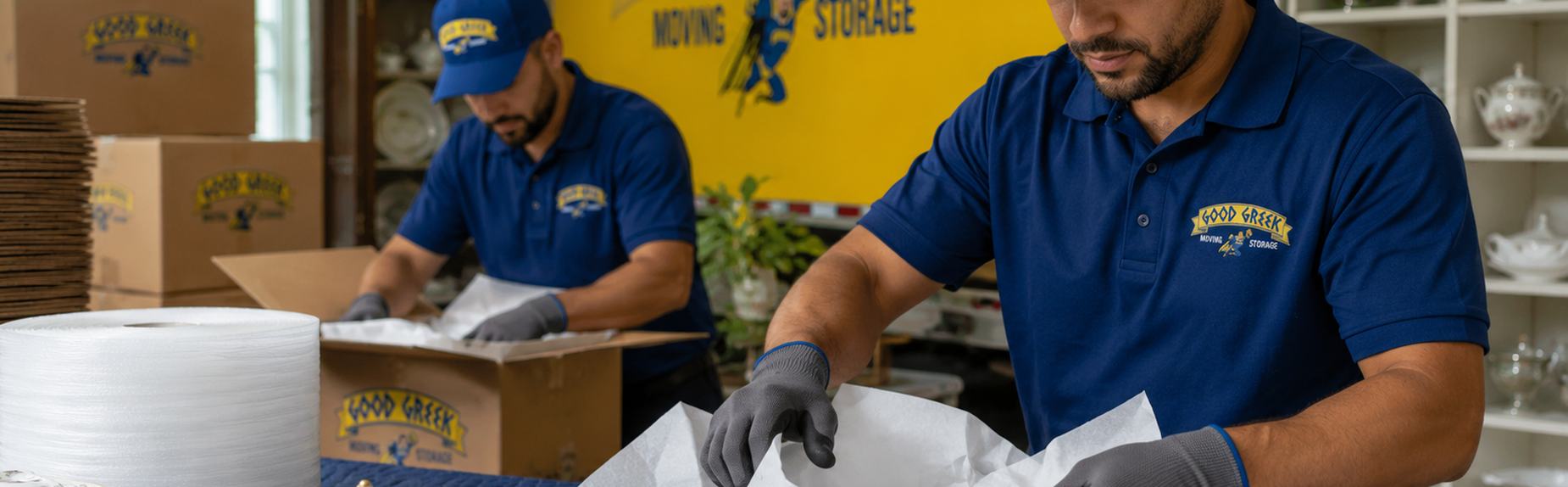
Wrap each piece of china individually with clean news wrap. Take several sheets of paper at a time and wrap them around the item starting from the corner. Continue to wrap the item diagonally, tucking in the edges as you go along. Add another layer or two of news wrap to serve as additional protection.
How to layer fine china pieces in your box
Bottom to top: heaviest and largest first, lightest and smallest last — with crumpled wrap as a cushion between every layer.
Add crumpled news wrap to the entire bottom of your box first. The bottom portion is best suited for platters and other large china and glass plates. Each layer above should consist of items lighter and smaller than those below it.
Flat items: plates and platters
Bundle individually-wrapped large dishes in groups of 2–3, secure with extra wrap, and stand them on edge — never flat — for vibration resistance.
Wrap large dishes individually in news wrap, then bundle with one or two other individually-wrapped dishes of similar size. Secure the bundle with two or more sheets of news wrap. The more you add, the more secure the dishware. Place the secure bundle in one of the rows on the edge of the box or dish pack.
Repeat the process, leaving no unfilled spaces around the bundles. Add crumpled paper on top of each bundle to create a cushion and protective platform for the next layer. Next, pack saucers, smaller plates, and shallow bowls in the same manner.
Bowls: mixing, cereal, and soup
Large bowls nest upside down in groups of 2–3. Shallow cereal and soup bowls stand on edge in the dish pack.
Bowls may serve as bottom or middle layers depending on their size. Wrap them the same way you wrapped the other pieces. Large bowls such as mixing bowls can be nested in groups of two to three, upside down. Shallow bowls such as cereal or soup bowls can be stood up on edge in the dish pack.
Sugar bowls
Wrap lid in tissue, invert lid on top of the bowl, then wrap both together as a single unit.
Lids should be wrapped in tissue. The lid can then be inverted on top of the sugar bowl. Take the sugar bowl and the inverted lid and wrap them together in news wrap, topping it off with another double layer of news wrap. Again, the more wrap you add, the more secure the item.
Cups: protect the handles
Wrap handles in extra wrap, pack cups upside down, and place all handles facing the same direction — uniform packing = uniform vibration absorption.
Cups should be wrapped individually, with handles protected by additional news wrap. Pack the cups upside down. If using a cell divider in one of your dish packs, they are packed correctly. Otherwise, wrap cups with an additional layer of news wrap and place them upside down on an upper layer, completing the process as described for plates. Make sure all cup handles face the same direction.
Cream pitchers and tea sets
Pack upright, never on the spout. Group small pieces — sugar bowls, cream pitchers, tea pots — together in the top layer.
Wrap pitchers in clean news wrap, topped off with another double layer of news wrap. Pack items such as sugar bowls, cream pitchers, and other smaller pieces of china and tea sets together upright in the box. Complete the layering process to the top as described for plates.
When to hire professional packers for fine china
Long-distance moves, heirloom or antique sets, and museum-grade collections call for professional packing plus full-value moving insurance. The only way to recover replacement cost if a piece breaks.
Whether you’re moving fine china or large items such as furniture, Good Greek Moving & Storage can help make your next move The Best Move Ever. The team operates across Florida, Nevada, and serving nationwide, and includes professional packing with full-service moves. Call (561) 683-1313 for a free estimate.
Packing Fine China: Frequently asked questions
What’s the safest way to pack heirloom or antique fine china?
Heirloom and antique china deserves double-walled dish pack cartons with cell dividers, acid-free tissue against the glaze (newsprint can scratch antique gilt), and 3–4 layers of unprinted news wrap on the outside. For pieces over $1,000 in replacement value, professional packing plus a separate moving insurance rider is strongly recommended.
Can fine china survive a long-distance move?
Yes — when packed properly. Most china breakage on long-distance moves comes from vibration over multiple highway hours, not single impacts. Double-walled cartons, cell dividers, and zero empty space inside the box are the difference between arrival intact and arrival in pieces.
Should I insure my fine china during a move?
If your china set is worth more than the carrier’s default coverage (typically $0.60 per pound for interstate moves under federal regulation), yes. Request Full Value Protection from your mover and declare high-value items separately. Good Greek’s full-service packing includes coverage details — request a free quote to see what’s covered.
Does Good Greek’s professional packing cover fine china?
Yes. Good Greek’s professional packing services include dish pack cartons, unprinted news wrap, cell dividers, and full-value protection. For collectibles and museum-grade pieces, white glove moving offers custom crating. Call (561) 683-1313 to discuss your china collection.