
Why packing dishes safely matters
Dishes are the most-broken items on moving day. The fix is the right box, vertical packing, and individual wrap with packing paper.
Of all the things you must handle during a move, dishes score high in the “most dreaded” category. So many things can go wrong, starting with breaking all the dishes. If this hasn’t happened to you once already, you’re probably worrying that this move is “the one.”
Fortunately, while there are no guarantees in life, there are steps to take that will cut down on the chances of breaking dishes. It takes planning, cautiously following some important steps, and plenty of packing paper. Read on to see how to pack different types of dishes for your move.
Packing Dishes Tips: Key Takeaways
- Use small to medium reinforced dish boxes, and pack plates vertically (on edge), not flat. Edge-packed plates resist breakage from bumps and jostles
- Three different techniques for three categories: individual + bundle wrap for plates, nesting bundles for pots and bowls, and paper-fill inside for cups, mugs, and stemware
- Label every box “fragile” and never overfill. Several smaller boxes are safer than one big overstuffed one
How to pack dishes for moving: step-by-step
Different dishes need different techniques. Six categories below cover plates, china, knives, pots, mugs, and the bonus tips that prevent the most common breakage.
The right boxes for packing dishes
Small to medium corrugated dish boxes, reinforced bottoms prevent the most common moving-day disaster.
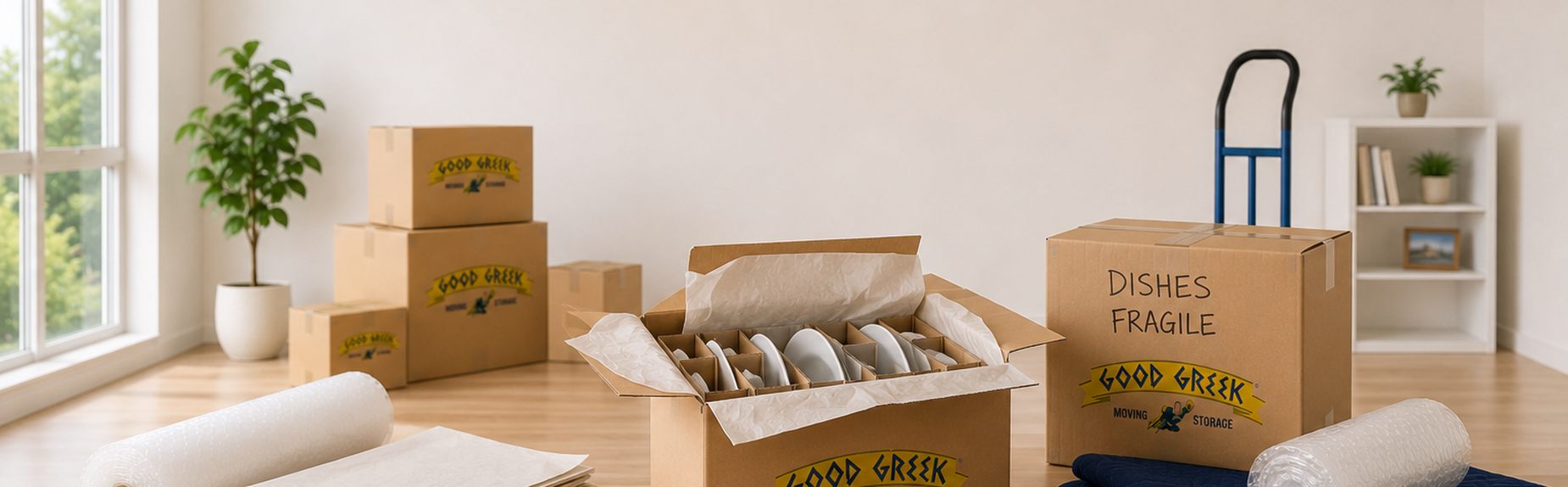
Small to medium-size boxes are best for moving dishes. Make sure the boxes are strong enough to handle the weight of the dishes. This eliminates one of the common catastrophes with moving dishes: the bottom falls open, spilling dishes that shatter on the floor. Some packing suppliers offer special corrugated boxes for dishes that are stronger. At the bottom of each box, place a layer of crumpled paper to help absorb any shaking that may occur.
How to pack plates for moving
Wrap individually, bundle in groups of three or four, pack vertically — never flat-side down.
Using newspaper or packing paper, wrap plates individually. Then, place them in groups of three or four and wrap them together into a bundle. Place plates into the box vertically (on edge), but make sure they are tightly packed. Fill any excess space with crumpled packing paper. Edge-packed plates resist breakage from bumps far better than stacked flat plates.
How to pack fine china
Multi-sheet wrap plus paper-lined box for high-value pieces. Double-walled corrugated cartons recommended.
All fine china and drinkware should get wrapped with several sheets of packing paper. Line the box with extra paper to provide more padding. For collector or heirloom china, use double-walled corrugated cartons designed specifically to protect fragile glassware and china.
How to pack knives and silverware
Knives get individual paper + bubble wrap with sharp-edge labels. Silverware stays in its tray, wrapped and taped.
Wrap knives individually in paper, then place them inside bubble wrap. Make sure to mark them so you are mindful of sharp edges when you unpack them. Other silverware can simply get wrapped and taped up in the silverware tray, then packed flat at the bottom of a box.
How to pack pots, pans, and bowls
Nesting bundles: nest progressively smaller pieces inside larger ones with paper between each layer, then wrap the whole bundle.
Place pots and pans in nesting bundles. Start with a large pan and line it with paper, then place the next size into the pan and repeat the procedure. Place the entire bundle upside down on wrapping paper and wrap the whole nesting bundle. This same procedure also works with bowls, saving box space and reducing breakage.
How to pack mugs, cups, and glasses
Fill each cup with crumpled paper, wrap individually, pack upright — works for stemware and everyday cups alike.
Gently fill each cup, mug, or glass with crumpled paper (this includes stemware). Then completely wrap each one individually. Some packers use a corner-to-corner roll method: lay the dish at the corner of the packing paper, then roll it across to the opposite corner, wrapping as you go. Place them in a box together in an upright position, then cushion the empty space with packing paper.
Bonus tips for packing dishes
Heavy items first, towel substitutes for paper, full cushioning, “fragile” labels everywhere, and never overfill.
A few extra rules will catch the breakage that the main techniques miss:
- Put the heavy items in the box first.
- If you run low on packing paper, use towels and dishcloths as backup padding.
- Cushion every box with crumpled paper at the bottom, sides, and top.
- Use packing paper to fill any empty space in the box — empty space means movement, and movement means broken dishes.
- Label every dish box “fragile” on at least two sides.
- Don’t overfill the boxes — several smaller boxes are safer than one big, overstuffed one.
Professional packing services from Good Greek
Skip the wrapping. Good Greek packs dishes, china, and kitchens for full-service moves across Florida, Nevada, and serving nationwide. Mover of the Year 2024 (ATA).
If you take these steps, you can cut down on the chance of breaking dishes during your move. With a full-service moving company, you can get your supplies directly from them. You can also opt to have them handle the packing for you. Good Greek’s professional packing services cover dishes, china, kitchens, and entire homes across Florida, Nevada, and serving nationwide.
Packing Dishes: Frequently asked questions
What is the best box size for packing dishes?
Use small to medium reinforced corrugated boxes designed specifically for dishes. Large boxes become too heavy and stress the bottom, increasing the risk of collapse. Specialty dish-pack boxes from a moving supplier or full-service mover are reinforced precisely for this purpose.
Should plates be packed flat or on edge?
On edge (vertically). Plates packed vertically resist breakage from bumps and jostles far better than stacked flat plates. Always wrap each plate individually first, bundle three or four together, then load them upright in the box with crumpled paper filling any gaps.
Can I use towels instead of packing paper for dishes?
Yes, as a backup or supplement. Towels, dishcloths, and t-shirts work for cushioning the bottom of boxes and filling empty space. They do not replace dedicated packing paper for wrapping individual plates and glassware, since paper conforms to shapes better and is cheaper per cubic foot.
Are professional packing services worth it for dishes?
For valuable china, glassware, or fragile collections, yes. Professional packers bring reinforced dish-pack boxes, double-walled cartons, and a documented packing system that reduces breakage and shifts liability to the mover’s insurance. For everyday dishes, DIY packing with proper technique is fine.